
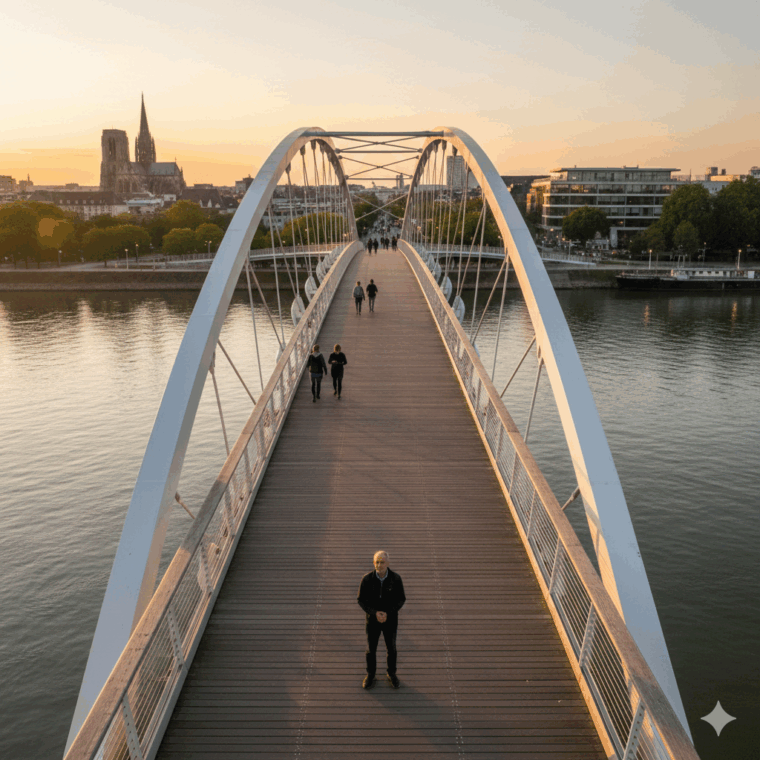
I recently came across a striking passage from John Hume’s Nobel Peace Prize acceptance speech while reading Fergal Cochrane’s Northern Ireland: A Fragile Peace—a book I sought out for its commentary on Mo Mowlam’s mediation skills. What I found was not just an interesting political observation, but a real insight into the psychology of conflict and a salutary reminder for anyone engaged in mediation and conflict resolution.
The insight hinges on the overwhelming difficulty for participants caught in the middle of a struggle to imagine a future free from that struggle.
Hume told the story of his first visit to the European Parliament in 1979.
“In my own work for peace, I was very strongly inspired by my European experience. I always tell this story, and I do so because it is so simple yet so profound and so applicable to conflict resolution anywhere in the world. On my first visit to Strasbourg in 1979 as a member of the European Parliament. I went for a walk across the bridge from Strasbourg to Kehl. Strasbourg is in France. Kehl is in Germany. They are very close. I stopped in the middle of the bridge and I meditated. There is Germany. There is France. If I had stood on this bridge 30 years ago after the end of the second world war when 25 million people lay dead across our continent for the second time in this century and if I had said: “Don’t worry. In 30 years’ time we will all be together in a new Europe, our conflicts and wars will be ended and we will be working together in our common interests”, I would have been sent to a psychiatrist. But it has happened and it is now clear that the European Union is the best example in the history of the world of conflict resolution and it is the duty of everyone, particularly those who live in areas of conflict to study how it was done and to apply its principles to their own conflict resolution.”
Trapped in the present
The power of this passage isn’t so much its celebration of European integration. (We do well to remember European integration was intended to prevent another war in Europe.) Its insight for me is about the state of mind of those facing conflict.
When people are in the throes of conflict—whether it’s a global dispute, a community crisis, or a painful personal/business separation—their present reality becomes a cognitive prison. The history of grievance is not a memory; it is a live wire, crackling with pain, fear, and resentment. The future is simply an extension of the intolerable present.
To a client sitting in a mediation room, asked to compromise or to imagine a cooperative parenting arrangement with the person they currently despise, the suggestion of peace can feel utterly delusional. It doesn’t seem like optimism; it seems like a request for self-betrayal or a denial of their legitimate interests. This inability to perceive a different outcome is not malice; it is psychological hardwiring.
The Mediator’s Responsibility: A Credible Vision
Hume’s meditation on the bridge highlights an important task for the mediator: You carry the vision when the clients cannot. By deploying ideas like the following, the mediator can help build a vision of the future and give that vision life until the participants can build their own.
- Validate the Pain, Isolate the Future: Acknowledge that, given their present experience, cynicism is completely rational. By validating past and present pain, you might start to create the trust needed to explore a hypothetical future.
- Use Micro-Successes as Proof: Where a ‘grand vision’ feels too remote, the mediator focuses on small, concrete steps. Each successful step is a tiny, credible piece of evidence that the impossible future is, in fact, possible.
- Frame the Future as a Choice, Not a Cure: The mediator is not asking the client to forget or forgive their history. They are asking them to choose a practical, functional, and less painful future. The aim is to move from “Will we ever be friends?” (impossible) to “How do we stop hurting each other legally/financially/emotionally?” (achievable).
Hume’s story stands as a reminder about how hard it is to be stuck in a conflict: it reminds us that our clients often walk into the room needing not just a facilitator, but someone who can lend them the courage to imagine something that can really feel impossible.